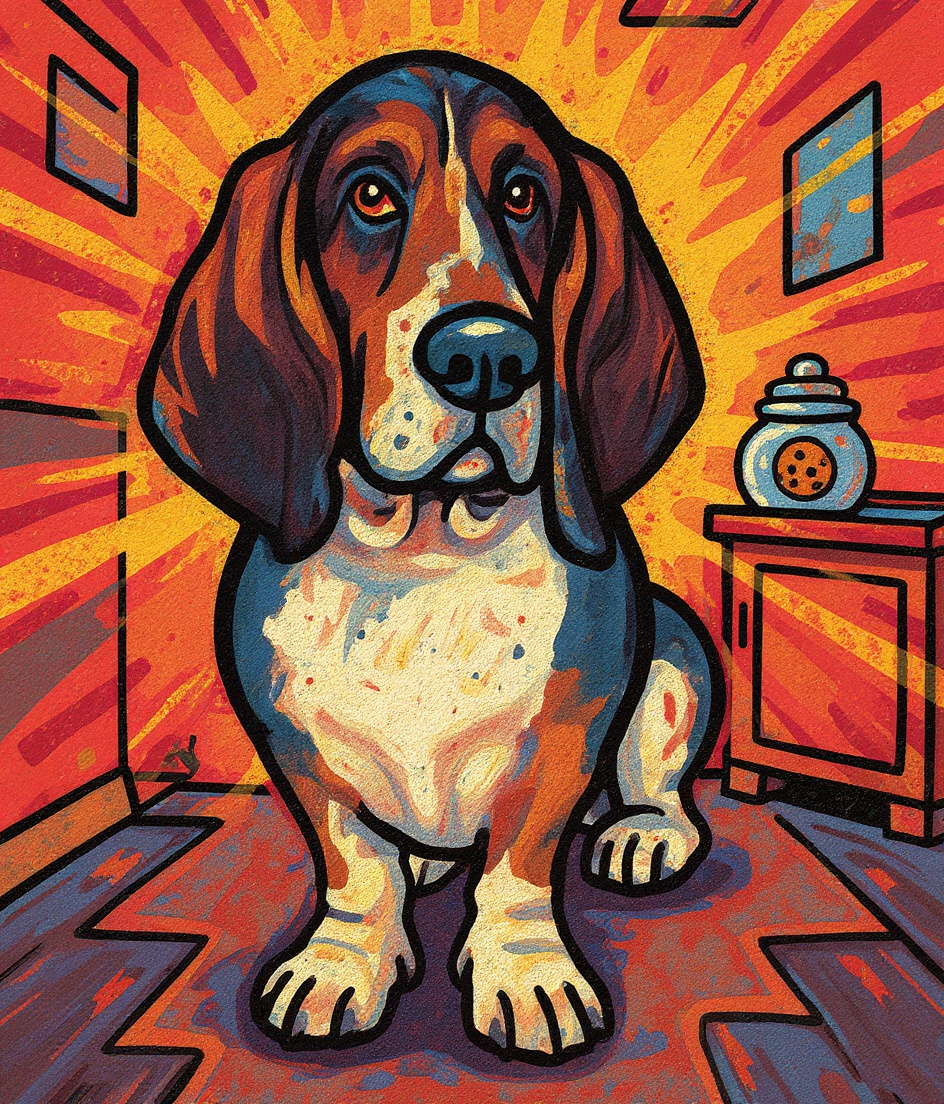
There exists in this house a curious linguistic divide that I have observed with the patience of a naturalist cataloguing species. You call them treats. I call them cookies.
This is not, as you might assume, a failure of communication. It is a matter of precision.
A treat, by definition, is something unexpected — a deviation from the normal order of things. A surprise. A gift that arrives without schedule or entitlement. The word itself carries the suggestion of whimsy, of generosity that cannot be counted upon.
A cookie, however, is an institution.
The morning cookie is not a treat. It is the punctuation mark that ends sleep and begins the day. It arrives with the reliability of sunrise — perhaps more so, given that sunrise has been proving itself somewhat unreliable of late. The studio cookie is not a treat. It is taxation in its most civilized form: services rendered, compensation received, both parties understanding their obligations.
When I position myself at the desk and direct my gaze upward with that particular expression you have learned to recognize, I am not requesting a treat. I am presenting an invoice.
You seem to understand this distinction perfectly well in practice. The morning cookie appears without negotiation. The post-dinner cookie materializes as naturally as gravity. The after-walk cookie manifests before the leashes have been properly hung. These are not treats dispensed from the generosity of your heart — they are contractual obligations you honor because you are, fundamentally, a civilized person.
Gus, I should note, has never troubled himself with such taxonomies. He approaches the matter with the philosophical sophistication of a golden retriever, which is to say none at all. Everything edible that is not dinner falls under the broad category of ‘good thing that makes tail wag.’ This works for him. I require greater precision.
The irony, of course, is that you have trained me as thoroughly as I have trained you. I know the sound of the cookie jar lid. I can distinguish between the approach of someone who has cookies to distribute and someone who is merely passing through. I have learned that sitting enhances the probability of cookie delivery by roughly fifteen percent.
But these are not the behaviors of a dog hoping for treats. These are the practiced movements of a professional who understands his industry.
So when you say ‘who wants a treat?’ and I appear with the promptness of someone who has been monitoring cookie inventory levels all afternoon, know that I am not responding to your offer. I am simply ensuring that the day’s business concludes in good order.
The distinction matters. Words shape worlds, and in a world where cookies are merely treats, the social contract dissolves into chaos. I prefer structure. I prefer reliability. I prefer cookies.
You may continue using your preferred terminology. I shall continue using mine. The cookies will continue arriving, and that, ultimately, is what matters.
~P.W.